
ONGOING PROJECT
MODEL2
Resilient Militarised Building Modules for Deployable Camps
Military Camp Control
Funded by the Ministry of Defence of the Republic of Slovenia, MODEL2 is developing a new generation of resilient, energy-independent and interoperable modular buildings for deployable bases. The project focuses on dual-use working and living infrastructure that combines energy efficiency, living comfort, adaptability and integration with wider camp systems.
The Challenge
Deployable modular buildings require more than a reliable electricity supply. Heating, cooling, renewable-energy integration, thermal management and suitable living conditions must be maintained under changing operational conditions.
Individual modules must also connect with the wider infrastructure of a deployable base. This requires an adaptable and interoperable architecture in which building, energy and environmental-control technologies can exchange information and operate as parts of a coordinated system.
The Solution
MODEL2 is developing an integrated modular-building concept combining energy-independent infrastructure, advanced heating and cooling, renewable-energy use, electrical and thermal energy management and intelligent management of the living environment.
The project is expected to deliver a technology demonstrator, final products, laboratory prototypes and a system for validating interoperability between modular building solutions. The resulting architecture is intended to support different operational configurations while maintaining energy efficiency, living comfort, operational resilience and coordinated management across deployable infrastructure.
Robotina's Role
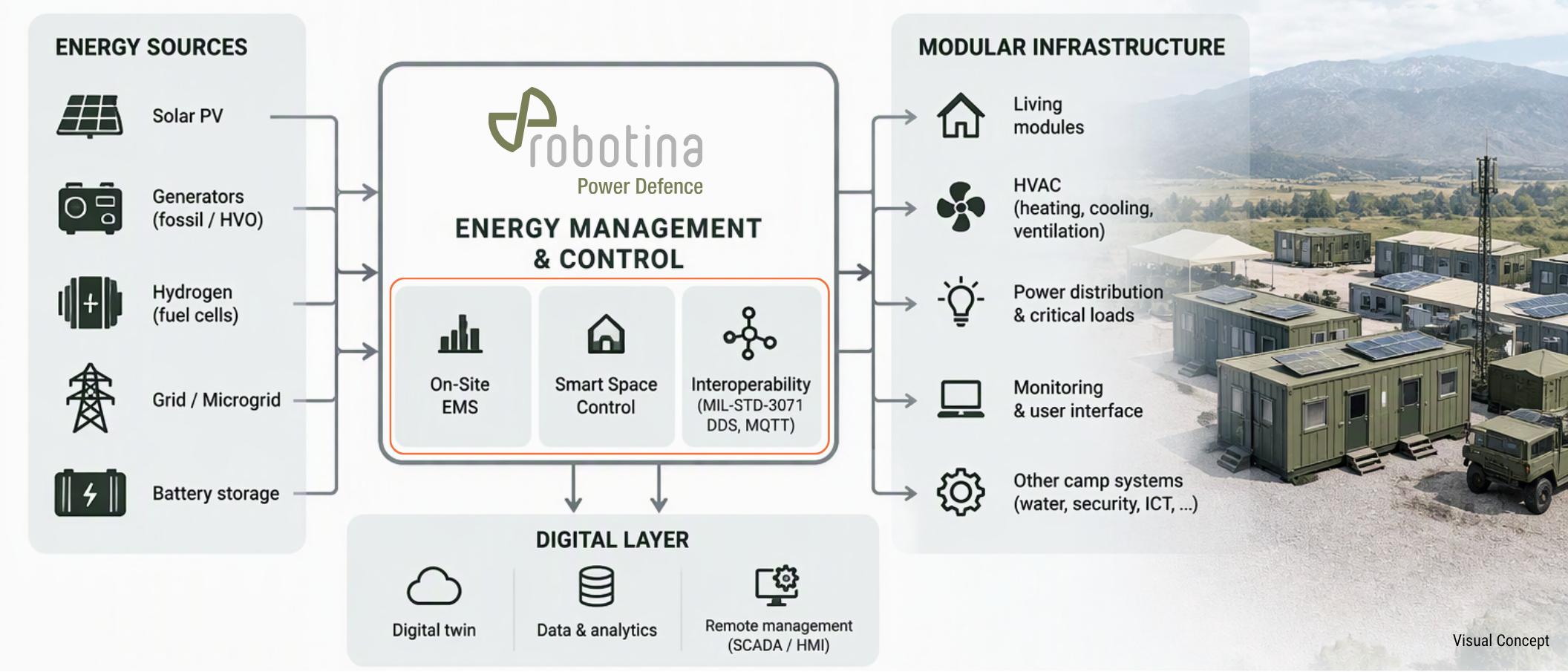
Robotina contributes to MODEL2 as an external technology provider, supporting the development and integration of energy-management, smart-space control and interoperability capabilities for modular infrastructure.
The solutions connect energy sources, battery storage, HVAC equipment, local controllers and the central user interface. On-site energy management coordinates production, storage and consumption, while smart-space control integrates comfort and technical-building functions into the wider management environment.
Expected Outcome
MODEL2 aims to deliver and demonstrate an integrated, energy-independent and interoperable modular-building concept for defence and dual-use applications.
The resulting solutions are intended to support greater energy autonomy, efficient operation, a high level of living comfort and improved interoperability across smart deployable bases.
Energy Management · Smart Spaces Control · Building-System Integration · Interoperability